
The Spring 2027 EDPEN Institute
April 16-17, 2027
Irvine CA
12 CE/CME Credits
Space is Limited
Save $100 with early bird pricing through January 31
Accommodations at DoubleTree by Hilton Hotel Irvine Spectrum
The Spring 2027 Institute:
Structured Recovery™
Equipping providers with a process to support faster, stronger healing through the core principles of Family-Based Treatment, adapted across the lifespan.
A continuing education 2-day, in-person training for medical, therapy, and nutrition professionals: from the frontline provider seeing an eating disorder for the first time to the specialist refining a Family -Based Treatment (FBT) informed practice.

Eating Disorders Show Up in Every Provider’s Office
Many healthcare professionals receive limited education in how to detect, assess, and respond when an eating disorder is present. EDPEN is committed to preparing providers to recognize eating disorders sooner and to confidently assess and begin addressing the patient’s needs.
Long waitlists, geographic barriers, insurance limitations, and workforce shortages routinely delay access to specialized treatment and higher levels of care. Those delays can have significant medical and psychological consequences for patients.
Structured Recovery™ was built to help close that gap.
Long Waitlists
Patients deteriorate while waiting for a specialist appointment.
Geographic barriers
Specialty care is concentrated in a handful of metro areas.
Insurance limitations
Coverage often lags behind clinical need.
Workforce shortages
There are not enough trained providers to meet demand.

It’s More Than a Conference – It’s a Start-To-Finish Training
The EDPEN Spring 2027 training is an opportunity for professionals across the full continuum of eating disorder care. It is designed for medical, therapy, and nutrition professionals, including eating disorder specialists as well as primary care and other frontline providers who may not specialize in eating disorders, but are often the first professionals to see the signs and symptoms.
Research tells us that one of the most effective approaches to care for someone with an eating disorder is Family-Based Treatment (FBT). This training teaches the most effective principles of FBT and adapts them to create treatment that meaningfully involves families and caregivers in the process.
Get ready to step into a novel framework built specifically to sharpen the care you’re already providing, one that gives you a structured pathway and a clear next step for every patient, no matter where or how they are struggling.
This training goes well beyond foundational education. The overarching objective is to help bring about faster, stronger recovery even when treatment stalls, plateaus, or isn’t progressing the way it should.
Wherever you are in your eating disorder work, there is a spot for you.
You’re new to eating disorder work, or not a specialist
You’ll begin with 2.5 hours of EDPEN pre-training webinars, designed to provide essential foundational knowledge and prepare you to fully engage alongside a multidisciplinary room of providers on Day 1.
Includes:
- Primary care physicians
- Pediatricians
- Nurse practitioners
- Physician assistants
- Registered dietitians
- Therapists and counselors
- School-based and college health providers
You already have experience in eating disorders
The Institute offers an opportunity to move beyond simply knowing eating disorder treatment and the principles of FBT to strengthen how those principles are applied in real-world clinical practice. Together, we will explore how the core principles can be adapted across the lifespan and integrated into the complex realities of multidisciplinary eating disorder treatment for all ED diagnoses.
- FBT-trained clinicians
- Eating disorder support staff
- Treatment center clinical leadership
- Supervisors and trainers

What You Will Learn
Through the developmentally adaptable framework called Structured Recovery™, providers will learn to:
- Detect and assess eating disorders earlier, particularly in frontline and primary care settings where eating disorders may otherwise go unrecognized.
- Prioritize medical safety and timely clinical decision-making, in line with APA level-of-care guidelines.
- Immediately initiate nutritional rehabilitation to support both physiological and cognitive recovery with the nutrition-first intervention
- Establish a clear, patient-centered behavioral management plan to address eating disorder behaviors.
- Build coordinated, multidisciplinary treatment teams that actively involve families, caregivers, and other support persons.
- Strengthen the practical application of core FBT principles
- Maintain a structured treatment pathway with data-driven goals, adapted to each patient’s developmental stage, circumstances, and level of care.
Five steps. One clear next action for every patient.
Structured Recovery™ gives providers across disciplines and levels of experience a clear, practical process for recognizing what is happening and determining what needs to happen next. It prepares frontline providers to practice effectively at the level of care where they are seeing the patient, while giving experienced specialists a structured framework for strengthening and refining their treatment approach.
Step 1 — Prioritize Medical Safety
Is this patient safe right now?
Medical instability hides behind normal labs and normal weights. Know what to look for before you plan anything else.
Step 2 — Determine Appropriate Level of Care
Where does this patient actually belong?
The placement decision is the one most often made by default by what’s available, what’s covered, or what the family will accept. There’s a better way to make it, and to defend it.
Step 3 — Initiate the Treatment Plan
What has to happen first?
Treatment stalls when the pieces go in the wrong order. There’s a sequence that gets patients eating and moving forward from day one.
Step 4 — Evaluate Whether Treatment Is Working
Is this actually working?
Even experienced clinicians can miss the window. There are earlier markers and a clear decision about what to change when the answer is no.
Step 5 — Advance Through the Phases of Recovery
What comes next if your patient is medically stable or after medical stabilization?
You’ll learn what that looks like and how providers can support a patient through these stages whether or not they were treated outpatient or at a treatment center first. Every patient will return home and knowing how to confidently guide them to reach full recovery requires ongoing treatment to bring them to an expanded and full life.
“At its core, Structured Recovery™ reflects a simple but critical truth: recovery begins with restoring the brain and body through nutrition.”
– Katherine Grubiak, RDN, Eating Disorder Treatment specialist with 30+ years of experience supporting patients toward recovery.
EDPEN Institute Registration Includes
April 16-17, 2027
Irvine CA
12 CE/CME Credits
- 2.5 hours of EDPEN pre-training webinars: foundational knowledge so every attendee arrives ready for Day 1. Included for all registrants; required for those newer to eating disorder work.
- 2 days of live, in-person training: instruction with a multidisciplinary room of providers. Limited to 200 participants.
- Lunch, snacks and refreshments provided to attendees both days
- The Structured Recovery™ framework — the complete five-step pathway, with guidance on adapting it across ages, family structures, presentations, and levels of care.
- 12 CE/CME credits: CME, CE for psychologists, CPEU for RDNs, NBCC
- Case application sessions: small-group workshops followed by faculty discussion and explanation
- Clinical tools and handouts: assessment prompts, level-of-care decision aids, family-meeting scripts
- Multidisciplinary networking
- Post-training access: Includes all pre-training webinar videos, session slides, handouts and materials
- Discounted hotel room $189/night for attendees at the DoubleTree by Hilton Hotel, Irvine Spectrum
- A full afternoon and evening after Day 1 (ending at 3:30) to enjoy the sights around Orange County!
Meet the Instructors

Ashe Davidson, MD, MPH
Division of Adolescent Medicine, UTHealth Houston
Dr. Davidson is a double board–certified adolescent medicine physician who specializes in the care of teens and young adults with eating disorders. She has expertise in co-managing anxiety, depression, and other health conditions and provides a weight-inclusive approach. She enjoys working closely with other clinicians in nutrition and psychology to provide comprehensive, culturally sensitive care for patients and their families.
More
A native Houstonian, Dr. Davidson completed her undergraduate education at New York University and received her medical degree from Texas Tech University Health Sciences Center School of Medicine in Lubbock, Texas. She returned home to Houston to complete her residency in Pediatrics and her fellowship in Adolescent Medicine at McGovern Medical School at UTHealth Houston. She currently practices in the Division of Adolescent Medicine at UTHealth Houston and serves patients in the Greater Houston area. Her clinical interests in Adolescent Medicine include polycystic ovarian syndrome, menstrual cycle disorders, eating disorders, and comprehensive well-child care. Dr. Davidson and her division serve as consultants for teen patients at Children’s Memorial Hermann Hospital. She is passionate about health care access, patient education, and provider education due to the sparse formal medical training regarding eating disorders. Outside of her clinical duties, she is assistant program director for the Adolescent Medicine Fellowship and coordinates the Adolescent Medicine rotation for undergraduate and graduate medical trainees.

Kristina Schwerin, MD
Medical Director, Align Treatment
Dr. Kristina Schwerin is a child, adolescent, and adult psychiatrist with over 15 years of experience providing psychiatric care and psychotherapy to individuals and families across the lifespan. She has practiced in a wide range of healthcare settings nationally and internationally and brings a collaborative, patient-centered approach to care.
More
Dr. Schwerin is board certified in General Adult Psychiatry and Child & Adolescent Psychiatry and has been practicing medicine since 2004. She is a Certified Group Psychotherapist (CGP), certified in Family-Based Treatment (FBT), and a Distinguished Fellow of the American Academy of Child & Adolescent Psychiatry (AACAP).
She earned her Bachelor of Arts (cum laude) from Princeton University, her MD from the University of Southern California School of Medicine, and completed her psychiatric residency and fellowship at the University of California, San Francisco. Dr. Schwerin is also a two-time Faculty Teaching Award recipient at the University of California, Davis Department of Psychiatry.

Katherine Grubiak, RDN
Director of Clinical Education at EDPEN, Founder of Nutrition Illumination
Katherine Grubiak, RDN, is a nationally recognized expert in Family-Based Treatment (FBT)-informed care for dietitians. She has trained dietitians across the country and internationally on how to bring modified FBT practices into their work as eating disorder providers, helping shape how the field approaches family-centered, evidence-based care.
More
As Co-Founder and Director of Clinical Training for the Eating Disorder Provider Education Network (EDPEN), Katherine expands access to eating disorder treatment by training and connecting health care providers across disciplines to deliver coordinated, family-centered care. She also serves as a master trainer and co-instructor of EDRD Pro’s FBT-Informed Eating Disorder Treatment: A Course for Dietitians.
Katherine graduated from the Coordinated Program in Dietetics at The University of Texas at Austin. She began her career in public health nutrition in San Diego and Los Angeles, with a focus on maternal and child health. While working in underserved communities in Los Angeles, she combined her passions for nutrition and dance by teaching and helping connect families of young dancers to public health clinic resources through the nonprofit Everybody Dance!, which received the National Arts & Humanities Youth Program Award from First Lady Michelle Obama.
Katherine’s work in multidisciplinary eating disorder treatment began at the UCLA Arthur Ashe Student Health & Wellness Center. She went on to develop a distinctive approach to FBT-informed care through close collaboration with Dr. Lauren Muhlheim at Eating Disorder Therapy LA, and later served as the eating disorder dietitian at Optimum Performance Institute in Woodland Hills, California, a residential program specializing in DBT-focused mental health treatment for young adults. She is also a contributing clinician in the development, testing, and training of the Recovery Record Family App, designed to enhance connection and support between families and clinicians outside of session.

Lauren Muhheim, Psy.D, FAED, CEDS-C
Psychologist and Owner at Eating Disorder Therapy LA
Lauren Muhlheim, Psy.D., FAED, CEDS is a psychologist, fellow of the Academy for Eating Disorders (AED), and certified eating disorder specialist (CEDS) and approved supervisor for the International Association of Eating Disorder Professionals (IAEDP). She directs Eating Disorder Therapy LA in Los Angeles. She provides cognitive-behavioral therapy for adults and family-based treatment (FBT) for adolescents and adheres to Health at Every Size® principles. She is certified in FBT for adolescent eating disorders and is the author of When Your Teen Has an Eating Disorder and the Weight Inclusive CBT Workbook for Eating Disorders. Dr. Muhlheim has held leadership roles in several professional organizations including the AED, IAEDP LA Chapter, and the Los Angeles County Psychological Association. She is an IAEDP core course instructor. She is passionate about removing the weight bias in evidence-based treatments and training other professionals to deliver such treatments.

Zach Appenzeller, Psy.D
Co-Founder & Director, Evidence Based Treatment Institute
Dr. Appenzellar is a Licensed Psychologist specializing in evidence-based treatment for eating disorders, OCD, anxiety, and mood disorders in children, adolescents, and adults with particular depth in longstanding challenges: high-acuity cases, tangled co-occurring presentations, and patients who have not responded to prior treatment. Alongside weekly outpatient therapy, Dr. Appenzeller provides 1:1 treatment intensives for eating disorders and for OCD and anxiety, delivered virtually across 40+ PSYPACT states or in-home across South Florida.
More
Dr. Appenzeller previously served as Founding Director of the UTHealth Houston Center for Eating Disorders, building and leading a full continuum spanning outpatient through inpatient care, and developed the FBT-Anchored Modular (FAM) Model there, a framework for personalized intensive eating disorder treatment anchored in Family-Based Treatment. Faculty appointments have included McGovern Medical School (Dean’s Teaching Excellence Award) and the University of Houston–Clear Lake. He is currently a Clinical Assistant Professor in Baylor College of Medicine’s OCD and Related Disorders Program, supervising trainees within an NIH-funded study on pediatric anxiety and OCD.
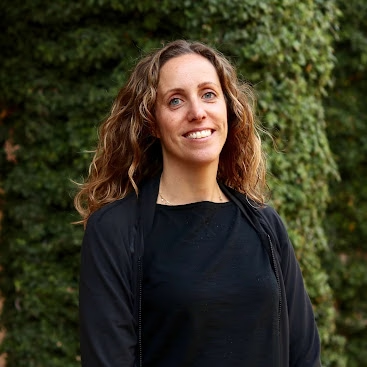
Certified Internal Medicine & Adolescent Medicine Specialist
Dr. Bar is a highly qualified and experienced physician with double board certification in Internal Medicine and Adolescent Medicine. Dr. Bar completed her Fellowship at Stanford Medical Center and worked as a Clinical Assistant Professor of Medicine at Stanford Medical Center. Dr. Bar provides expert care around the medical complications of malnutrition, eating disorders and disordered eating, with a compassionate and specialized, well rounded approach. She is committed to improving patients’ overall mental and physical well being.
Pricing
Maximum capacity of 200 attendees and special early bird pricing, so don’t wait!
Professional
$599
$499
- Save $100 before January 31st.
Student
$199
- Does not include CE/CME